Showing posts with label photography. Show all posts

Can Photographer Control Photos From Fashion Shoot?


Dear Sir/Madam: I am a freelance photographer and I am also working on an upcoming online fashion magazine. Recently I organized a photo shoot with a few models I have founded via Internet and a designer who agreed for the models to wear his clothes for the photo shoot purposes. The designer refurbishes and sells branded clothes. Everyone agreed to the photo shoot on these terms:
  • Everyone gets the photos for their own usage 
  • I will use the pictures however I want, and also the ones I choose will be featured in the online magazine 
  • No fees charged on anyone including models, designer and myself 
It's a verbal agreement with everyone and not written. It may not have any value in the eyes of law. Now however the designer (the person who allowed us to use his clothes for the shoot) is giving me trouble setting me deadlines and choosing the pictures I can use for the magazine or anywhere else. I want to use the photos that I want to use, the way I want to use them and whenever I want to. He claims it would be illegal if I used the photos anywhere without his permission and supervision. He hasn't got any photos from me yet so he can't use any either for his own purposes. I would like to know whether I am allowed to use the photos that I took that day, the way I want to and without any restrictions. Or would I have to at least mention his name or his shop's name? We haven’t signed any copyright releases etc. Also would I need to get the models release if I want to upload the pictures? I would like to add that the photos will be used for editorial purposes only and non-commercial. We're back with the "Dear Sir/Madam" that starts your letter. What prompted your uncertainty as to gender? Can Rich be used as a woman's name? There is a female equivalent for Richard -- Richelle (and we were excited to see that a Richard and a Richelle recently married). But we're not clear whether a woman writing this column would be addressed as Dear Richelle, or Dear Rich (or perhaps the more endearing Dear Richie). As a further digression, our research unearthed some surprising data regarding the number of serial killers named Richard.*
Right, you had a question. Unless there is a written document evidencing copyright transfer, you, as photographer own copyright in the photos. You control the reproduction and distribution and you're free to choose and reproduce the photos you want for your magazine. If the verbal agreement is enforceable -- that depends whether there is sufficient evidence to prove the terms and conditions -- you would have to abide by those terms, as well. Even if the verbal agreement is valid, it doesn't preclude you from doing what you want -- choosing the photos you wish to use in the magazine. (And you would be obligated to provide copies of the photos to the other parties.)
Do you need to mention the designer? We're not sure why you have to mention the designer or the designer's store, unless you're contractually bound to do so. The designer has no copyright in clothing design unless he's stitched in some unique artwork--for example, he's added intricate needlepoints. In any case, it might be a nice professional touch to credit the designer as fashion readers expect that information.
What about model releases? Releases are needed to head off two types of problems: invasion of privacy (you may be invading the model's privacy, for example, by showing her partially nude); or violation of the right of publicity (you're using the model's image to sell something). Typically, editorial non-commercial uses wouldn't trigger the right of publicity but with Google AdSense and similar Internet schemes, it's difficult these days to tell sometimes whether an image is being used for commercial exploitation.

*Serial killers named Richard: Richard Angelo - The Angel of Death, Richard Biegenwald - The Thrill Killer, Richard Chase - The Vampire of Sacramento, Richard Cottingham - The Torso Killer, Richard Macek - The Mad Biter, Richard Ramirez - The Night Stalker (and speaking of notorious killers, there's also Richard Loeb (of Leopold and Loeb infamy).

Can We Pilfer Celebrity Photos From IMDB?

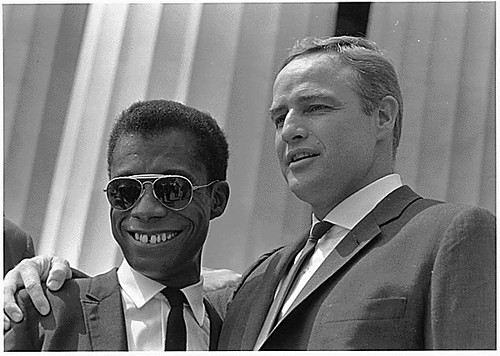
Marlon Brando and James Baldwin
at 1963 March on Washington
Dear Rich: I wanted to post some photos for a celebrity article at my website. I’ve totally forgotten rules regarding photos. Can I pilfer IMDB and give an attribute to them or do I actually need their permission? Are there any secret public domain photos for celebs you know about? The copyright in celebrity photos is owned by the photographer (or by the agency to whom the photographer has transferred rights). We doubt whether the IMDB owns rights in all the photos it posts. Most likely, it's acquired those rights from the copyright holders. Often large celebrity-styled sites have ongoing 'subscription' deals with the companies that own photo rights such as Getty Images, PR Photos, PictureLux, and Shutterstock.
Operating without clearance. If you work for a website company, you're best off not jeopardizing your job by using unauthorized photos. The price you'll have to pay -- time, threats, lawsuits and payments -- if you're caught will far outweigh the licensing costs. If you're just posting a photo occasionally to your personal blog, you're less likely to get hassled but beware that photo agencies employ various means of tracking digital photo use including digital watermarks and embedded metadata.
Right of publicity. The rules we provide here are for websites where you are using the celebrity photo as a means of illustrating a story about the celebrity -- for example, you're discussing the funny side of Mike Tyson. If you are using the celebrity photo to imply endorsement of your site or to sell a product or service, you'll need the celebrity's permission as well.
Public domain photos. There are some public domain photos of celebrities. Try sites such as Wikimedia and read and observe the terms of the licenses. We're not so sure about so-called public domain photos at other sites -- that is, whether the photos are actually in the public domain. We typed in "public domain celebrity photos" and found mixed results (including pictures of Dwight Eisenhower and Britney Spears -- we don't want to think about the potential mash-up!). Of course photos taken by government employees -- for example, Elvis shaking hands with President Nixon (soon to be a movie) are in the PD. We think that's the case with our photo of Marlon Brando and James Baldwin (above) -- perhaps taken by an FBI agent. (And here's a related video made around the same time).

Wants to Use Historical Photos in Book

Dear Rich,I have photos I want to use for a book I am writing. The photos were given to me by the photographers. As far as I know these photographs were never published. They photos were taken in various years including 1914, 1924, and 1965. The photographers are all now deceased. However, the people who gave me the photos were informed that I was writing a book about local history and were going to use the photos for research. Can I use these photos in my book? Do I need to try to contact the descendants of the photographers in order to get permission or can I just credit the source of the photographs? I also want to use a photo I found in a history book. The photo is a pre 1923 portrait of a local man. The caption for the photo reads “Courtesy of William B. Secrest, Fresno, California.” Secrest is the author of the book and owns the original photograph. Do I need to track down William Secrest or can I use the photo without permission since it is pre 1923? The history book was published in 2002. I would of course appropriately cite the photograph. We think you'll be okay to use all of the photos described, but it gets a little complicated.
The 1914, 1924, and 1965 photos. If the photos were never published and the photographers died before 1941, the works are in the public domain (Here's the official explanation). Otherwise, the unpublished photos will not become public domain until the author has been dead for 70 years. (Based on this rule, the 1965 photo could not be in the public domain.) Even though your one or more of your uses is likely to be unauthorized -- and an infringement --  we think that you will have a strong fair use argument, and we also think that the likelihood that the descendants of the photographer will learn of your use (or care) is slim. A commercial publisher may require that you indemnify the publisher if there is a problem. You may want to consult an attorney at that point.
As for the pre-1923 portrait. If the pre-1923 portrait was first published with authorization before 1923 it's in the public domain and you're free to use it. If it was first published after 1922 but before 1964, the photo is in the public domain if it wasn't renewed (and most were not). If the first publication was in 2002, and the author died before 1941, it is also in the public domain. (See, we told you it was complicated). As for the prolific California historian William B. Secrest, we think -- and we could be wrong -- that he owns the photo and lent it for use in the book. The "courtesy" he has extended is that he provided access to the photographic print. Was there a copyright notice associated with the publication in the 2002 book? That could also be indicative, though not decisive as to the photo's copyright status.

The Weekend

Hope your weekend looks something like this!

[photo cred here]

HiJacked and Automatic Photography

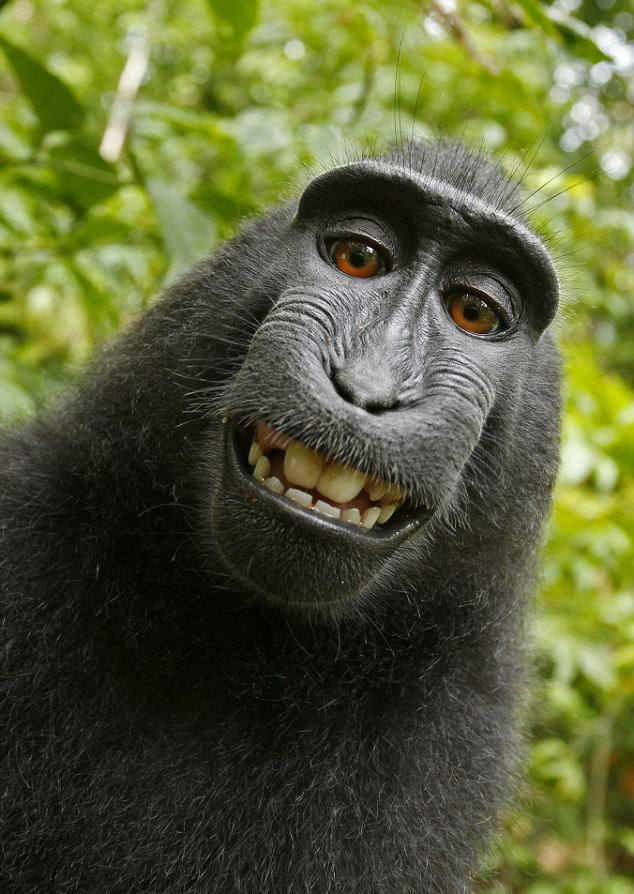
Dear Rich: You have no doubt heard about the copyright dispute over the self-portrait taken by a black macaque and photographer David Slater. In a discussion of this story at the Online Photographer it was claimed that copyright law forbids the assignment of copyright to a person in the case of photos that are taken automatically. This would seem to invalidate the copyright of most of the famous strobe photos of Harold Edgerton, for example - though MIT currently claims copyright on his photographs. So what's the scoop on copyright and automatically-taken photographs? Although the photos that you mention all have something in common -- a human did not press the shutter -- their copyright status actually varies depending on factors that we'll discuss below.
Artwork created by animals. We've followed the careers of various animal artists trained to create paintings and music (Ruby R.I.P.) and we believe that these works cannot be protected under U.S. copyright law. (P.S. for those seeking to invest in elephant art, watch out for the fakes!) According to the U.S. Copyright Office rules, only a human may create a 'work of authorship.' Those same rules prohibit registration of works owing their form solely to forces of nature and without human intervention -- such as driftwood. Although Copyright Office rules don't have the force of law -- the Copyright Act itself does not make these same anti-animal, anti-nature artist pronouncements -- these Copyright Office regulations are commonly accepted by the courts. For that reason, we believe that it would be difficult to (1) acquire a registration in the United States for the macaque self-portraits, and (2) for Slater's so-called assignees to maintain a lawsuit against an alleged infringer.
Photos in which a human did not press the shutter. There's a big difference between a photo taken by an animal and an "automatic," programmed, or computer-generated photo. For example, a photo taken with a timer can be copyrighted by the person who set up the camera and the timer. Similarly, a photo triggered by magnetic fields, or triggered by stroboscopic flashes, can also be copyrighted by the party who programmed the camera. By way of analogy, author Stephen Fishman points out in his "amazing treatise" on the public domain that the Copyright Office has registered hundreds of computer generated musical compositions and even a literary work written by a computer in the style of author Jacqueline Suzanne. In this manner if Slater had set up his camera to capture the "Cindy Sherman of Monkeys" and the shutter was programmed to capture the macaque each time it moved, Slater would arguably maintain copyright even though he was not present when the macaque said 'Cheese.'

Are Nonprofits Liable for Photo Infringement?

Dear Rich: I have been collecting black-and-white snapshots at antiques shops and flea markets for several years. This year i started posting some of them with slightly irreverent captions on my website. I think I understand that orphan works produced before 1923 are considered to be in the public domain. But what about the later photos? I haven't been too concerned about copyright violations because it is a nonprofit site. However what if I wanted to reproduce the images for profit? What kind of legal issues would I face? We think you're operating under a few misconceptions so maybe we should clear those up, first.
Nonprofits can be liable for infringement. Being a nonprofit won't shield you from a lawsuit. Nonprofits are occasionally named as defendants -- for example, the Internet Archive was sued over its caching of old web pages (and some nonprofits have filed suits as well). Nonprofit status may affect fair use determinations (as explained here). But in general, it makes little difference for purposes of determining infringement, whether the theft was for profit or not. You should also be aware that nonprofit status is a corporate tax status; a failure to profit doesn't make you a nonprofit.
Orphan works are not public domain. You are correct that works published in the U.S. before 1923 are in the public domain in the U.S. But these are not orphan works. An orphan work is one that is still protected under copyright but whose owner is missing in action and there's nobody to contact for permission. We think that's the case with most of the photos at your website.
Right, you had a question. We think the odds are slim that you will be the subject of a lawsuit. A copyright owner of one of your vintage photos (the owner would be whoever took the picture) is unlikely to see your work, unlikely to threaten a lawsuit and unlikely to recover much if the lawsuit should it actually go to court. So the chances are low that you will be hassled. Still, for the record, these are infringements. There is also a slim possibility that one of the subjects of these photos will see your site and claim an invasion of privacy or (if you sell the images) a violation of the right of publicity.  Again, unlikely, but possible ... kind of like guessing whether an earthquake will hit Virginia.

Has Roy Orbison Negatives

Dear Rich: I read an article about a man who took pictures of the Beatles when he was a teen and recently sold them. That got me thinking about my 23-year old negatives I have of the singer Roy Orbison and his family. I was working on a Christmas card for the family and shot several rolls of film. A month and a half after the photo shoot Mr. Orbison passed away. As the photographer I had them sign a release and I still maintain the negatives. Question is: Do I have the right to print and market those images? If so, what do I need to market images and how far may I go in creating additional marketable images? OMG! We just realized Roy Orbison has been gone for almost 25 years! It seems like yesterday that the In Dreams star passed away. What has the Dear Rich Staff been doing all these years?
Right, you had a question. The short answer is that you can sell copies of your photographs (prints) and you can license the photos for editorial uses such as books and website articles. But you cannot license them for commercial uses such as product endorsements or merchandise unless such rights were conveyed to you by the people signing the releases (unlikely).
The longer answer. There are three legal principles at work: copyright, contracts, and the right of publicity. Unless the photos were done under an employment relationship, copyright grants the photographer (the person who took the pictures) the right to copy and create derivatives of the photos.  The right of publicity allows the subject of the photo to control the way their image is used for endorsements and merchandise. Contracts are used to transfer these rights. So, the photographer retains copyright unless a contract transfers that right and the subject retains the right of publicity unless that right is transferred by contract (for example, a release). For that reason, you will obtain the most reliable answer after someone reviews your photo releases to determine what rights were granted to you.

Finding happiness in Denmark

Have you ever been to Denmark? These beautiful vintage photos are from Denmark's national library. (Fun fact: Some of the photos were staged. The photographer wanted to give people a happy escape from the unemployment, despair and depression in the 1930s and 1940s.)

P.S. Our England vacation photos coming up tomorrow, excited to share...xo

(Photos by Sven Turck, via My Modern Met)

Can They Use Photos of Our Home in Magazine?

Dear Rich: We are restoring our home in Atlanta and our architect had asked me near the beginning of the restoration to fill out a questionnaire about the experience of working with him. I did so very positively. The relationship has since cooled a little, and recently we became aware of an article published about us and our home in which my responses were modified and used extensively as direct quotes by the writer as if she had talked to us. We had never talked to the writer or knew anything about the article. Many quotes were attributed to my wife who had never seen the questionnaire. The article also included pictures taken of the home from on our property. And, the writer had us quoting someone from the Historical Society saying something that he never said and that we never said he said. The feature ended with a bold-faced paragraph saying, "Look for an update...in an upcoming issue." We do not want another story done by this publication. Do we have legal rights to prevent them from using photos of our home--interiors and exteriors shot from our property--that are taken by the architect?  We assume that the architect instigated the article, so practically we think the best course is to notify him and ask him not to publish any more photos of your home or publish any more statements attributed to you or your wife. We think the letter will work best if it is flat and matter of fact, not harsh, legalish, or argumentative. The prudent response from the architect would be to comply.
The Legal Analysis. In answer to your specific questions, a magazine would need permission from the copyright owner of the photos (the architect, apparently) and would only need a property release for the interior pictures assuming they were taken without the authorization of the homeowners. That may be the case here but it's probably not worth hassling over and it may be difficult to prove without losing money on attorney fees.  Exterior photos of your home taken from public locations can be used for editorial purposes without your consent. Using your quotes without permission is probably a violation of copyright law, unless the architect can demonstrate that you consented or that your consent was implied, or there is a fair use defense.
Ennyway ...  all you really want is for people to behave properly in the future and most of the time, you can accomplish that with a well-written letter. Of course, if this isn't one of those times, then it may be worth having an attorney write them a letter to set things straight.

Have a wonderful weekend.

My lovelies, what are your plans for the weekend? This evening, Alex, Toby and I will be flying across the Atlantic Ocean to this little village in Cornwall, to visit my grandmother, aunts, uncles, dad, brother, sister and cousins. We're sooooo excited to swim in the freezing cold water and eat Cornish pasties all day. :) Next week, I'm happy to have some amazing guest bloggers writing openly about family, marriage, work and life. (Alex and I have loved their posts so much, we've talked about them for hours, no joke!) Anyway, have a wonderful weekend, and here are a great few posts from around the web...

Rad new stamps.

Monkey self-portraits!

This chic magazine editor looks like a grown-up tomboy.

Birthday balloons, too cute.

Vintage maps as wallpaper.

Breaking the rules in plus-size fashion.

What a sweet anniversary post.

Crikey, look at Elizabeth's gorgeous jeans. Now I'm dying for a pair (which I tracked down here.)

FASCINATING post about being the breadwinner of your family.

Great supplies for crafts.

Holding a starfish.

The Design*Sponge book trailer is SOOOOO cute!!! pre-order the book here. Congratulations, Grace!

Plus, five Cup of Jo posts you may have missed:
* Seinfeld reruns.
* France vs. America.
* Banana bites.
* Waterfall madness.
* Lipstick trick.

(Photos by Andrew and Carissa)

Dancing

Isn't this photo of a dancing couple lovely? The print would look beautiful framed (or wrapped up with a red bow as a wedding present).

Puppies

Oh my goodness, this news story made my eyes pop: West Village pet shops have banned "drunken puppy buying." In the evenings, tipsy passersby stumble home from neighborhood bars, fall in love with puppies in the shop windows and drunkenly buy them...only to wake up the next morning and realize that they have a new puppy! Isn't that crazy?

(Thanks, Sophie. Photo by Serena Solomon)

Adventures in babywearing

At our friend's cabin upstate, Toby loved the friendly grown-ups and wanted to be in the middle of the action at all times. But Alex and I could only chase him around and keep him from falling off the dock for so long, so the sling turned out to be a perfect way to keep him happy and immersed. Here, we're fishing with friends--it was the first time for both Toby and me! (We caught nothing:)

Another early, chilly morning during our trip, we walked by a babbling stream and paused to watch the water flow by. It was so relaxing (I caught myself thinking that it sounded just like a noise machine, ha!), and Toby's head rested more and more heavily on my chest until I realized he had fallen asleep. (My other clue was a stream of drool flowing down my decolletage, such that it is.) So I sat down on a bench while the pink sun rose in the sky, and read Operating Instructions while he slept. I wish I had photos of that sweet moment, but Toby and I were the only ones awake! I took a mental snapshot, though. :)

Anyway, the sling was such a lovely addition to the weekend and a wonderful way to have adventures with a baby as a trusty sidekick.

(The only catch is that it makes it tricky to drink a pre-dinner PBR.)

P.S. This post is part of the Sakura Bloom Styleathon, hosted by my friend Leigh. Read more here, if you'd like. Thank you again to Leigh for introducing me to the genius of slings, which are becoming part of my life in beautiful and magical ways.

Daydreaming

This weekend, we joined some friends at a lakefront cabin, an hour north of Manhattan. Every evening, after Toby fell asleep, Alex and I would sit on the dock, drinking white wine (my favorite) and chatting about nothing in particular. It was so beautiful and peaceful. I want to beam myself back there right now. xo

How was your Fourth? Hope you had a good one.

Sexy eyebrows (yes, eyebrows)

Oh my goodness, how gorgeous are these dramatic eyebrows? When I saw these stunning photos of Oscar de la Renta's recent runway show, my jaw dropped. Makeup artists often insist that eyebrows are the most important part of your look, since they frame your face and can make your eyes look bigger and make your face look younger. Wouldn't you love to recreate these sexy bold brows for a night out?

Happily, my make-up artist friend Suzy Gerstein shared the two steps to getting the look: "The secret to a gorgeous full brow is to layer products. First, sketch in any sparse areas with hairlike flicks of a brow pencil. Use the skinniest, pointiest pencil you can find, so your drawn-in 'hairs' will look natural. My favorite is the Kevyn Aucoin Precision Brow Pencil. Then layer a powder color over the pencil. Two colors that work well for brows: MAC eye shadow in Brun (for brunettes) and Concrete (for blondes)."

What do you think, my lovelies? Would you dare? xoxo

(Photos by Jamie Beck. A similar red lipstick is Rouge Dior in Red Muse)

The Children of the Russian Rich

German photographer Anna Skladmann's portrait series features children of the new Russian elite. "They live in a secluded world," says Skladmann, who spent years befriending and photographing the little ones. "Their parents are attempting to make up for the Soviet times--they only want the best for their children. They receive private language lessons; they go swimming or play tennis. The lives of these children are very planned and regimented." This interview and these slideshow captions are fascinating.

P.S. The series reminds me of the riveting documentary Born Rich about American heirs and heiresses. (Have you seen it?)

Happy Fourth of July!

Happy Fourth of July! Hope you had a wonderful, relaxing, firework-y weekend. xoxo

(Photo by Spencer Tweedy)

Wanderlust

Photos of Norway and Paris to add some wanderlust to your morning. Where would you like to go right now, if you could go anywhere?

P.S. Click on the top photo; it looks beautiful when it's blown up!

(Photo credits unknown)

Motherhood Mondays: 8 confessions of a new dad

For today's second Motherhood Monday post, I'd love to talk about new fatherhood. On the three-hour drive home from the beach this weekend, Alex and I started talking about parenthood, and he revealed a few funny and surprising thoughts on our first year with a baby. Here were his eight revelations, in his own words...

1. "I didn't bond with the baby right away."
The experience of fatherhood is thrilling, but so hard at the same time. I loved Toby from the second I saw him. But the first few months, to be honest, were pure adjustment. The baby is so helpless, and you're so clueless, and you don’t have that strong chemical, hormonal and emotional bond with the child, in the same way the mother does.

You spend the first six months of your baby's life cramming this giant rule book. You have to learn everything—how to hold the baby, how to swaddle, how to change a diaper. I had never played with dolls or even babysat, so it was totally, totally new.

I did enjoy it--it was a fascinating odyssey and deeply satisfying--but, secretly, at the same time, if Joanna had walked in and said, "My mom's going to take over for the next month," I would have been thrilled.

2. "Time alone with the baby was surprisingly profound."
Even though I felt so lost overall, I was surprised by how spending time alone with Toby felt natural and surprisingly not scary. I remember the very first night we had Toby at home. Joanna was in bed, and I had four hours alone with him. He was sleeping in the bassinet next to me, and started to stir. I realized that he had never heard music before and that I got to pick out the first song he'd ever hear. I felt like I had a hand in shaping his destiny. Choosing a song on iTunes suddenly felt profound! I decided on "Penny Lane" by The Beatles. It was bright and optimistic, like the first day of spring. It was a magical moment.

3. “My wife acted a little like she was on drugs.”
Up until you have a baby, whatever happens, you and your wife pretty much respond the same way. You're on the same wavelength. But once the baby arrives, every thing that happens, your wife has a 90-degree different take.

Joanna's highs were higher, and her lows were lower. Her general joyfulness was so high; she was starry-eyed and blissed out. On the flip side, she was more anxious. She was more inclined to take any negative thing to heart—such as Toby fussing while we changed his diaper. I figured his fussing was a small, unfortunate but inevitable thing, but it felt incredibly urgent to Joanna. She got really upset by his crying—for her, it was like an alarm clock was going off inside her. She had an extreme surge of anxiety at any possible sign of disturbance to Toby, whereas I would address his crying but it wouldn't bother me on an emotional level. I just thought, Oh, all babies cry, he'll be ok.

It's like being with someone on drugs. You're on a different plane. You look at your wife, and you have to imagine, 'What exactly are you feeling? How does the world look to you right now?' Then you have to figure out how to respond the way she would want.

Everything does come back down to earth again. Your wife no longer feels those extreme surges at both ends of the emotional spectrum and becomes more like her old self (which is a relief to her, too), and you get more acclimated and feel like your old self. By about month nine, we found ourselves settling back into our old rhythms and feeling like ourselves again (see below:).

4. "I was nervous that my wife would like the baby better."
Maybe it sounds crazy, but a great fear I always had about having children was that my future wife might like them better. In many of my friends’ families growing up, the husband was basically replaced by the kids. There's nothing more primal than the love between mother and infant. I was absolutely worried about being dropped a notch.

Once Joanna was putting Toby to bed and I heard her tell him, "You're my favorite person in the whole world, do you know that?" and I was thinking, 'Really? What about me?' It sounds ridiculous, but it was an adjustment not to be the only man in her life. But in the end, I saw that our marriage could never be replaced by a baby—it's such a different thing. That realization was a huge relief.

5. “Children's books are boring.”
I love spending time with Toby, especially when we go on walks or play the guitar. But some baby activities are s-l-o-w. Many women seem to have a tremendous capacity to step outside themselves and see things through the baby's eyes, like reading children's books. But to me, children's books are fundamentally boring. Like, mind-numbing. The Very Hungry Caterpillar is tough sledding.

6. “Everything turned a corner at nine months."
I once heard a theory that babies are inside the womb for nine months, but that they're remain in the gestational period outside the womb for the next nine months.

Everything changed when Toby was nine months old. One day, Toby didn't seem to know who I was (or care!). But the next evening, I got home from work, and Toby was eating dinner in the high chair, and he looked up at me and smiled and shrieked and did jazz hands. He recognized me! It was amazing. I felt like we had truly connected. Honestly, for the first time, he didn't only feel like my baby, but like my son.

7. “I daydream about the future with Toby.”
I often daydream about Toby growing up: listening to music, taking him on boats, teaching him how to cook a great omelet, telling stories about "the old days." I always picture us on hikes for some reason—even though I don't really go on many hikes. My father and I used to sit around for hours some nights and plan my future, and I love the idea of being on the other side of that conversation. I also look forward to imparting lessons that my dad didn't give me—like how to ask out women.

8. “I'm ready for another.”
With your first baby, it's really tough. Every day is a surprise. But now I know that I can do it. Raising a child for the first 12 months of their life is a skill I now have. Having a second baby? Believe it or not, I can't wait. :)

Thank you, Alexei! My lovelies, do you think own dads had to adjust to having children? Fellow mamas, did your husbands immediately take to new parenthood, or did they find the transition tricky? Have they said anything about the experience? If you're a guy, what are your thoughts on fatherhood? I would love to hear... xoxo
Can We Use Sam's Club Photo in Manual?

Dear Rich: I have a photo of a bunch of electrical conduit inside a main electrical room at a Sam’s Club. The store manager gave the person who took the photo verbal permission to use it for educational purposes. There is no way to tell that the photo was taken inside a Sam’s Club. It’s just a bunch of nicely installed electrical conduit inside a small room. I want to use the photo in some electrician training curriculum my organization is developing, and we want to sell the curriculum to a client. Your book talks about using photos people take of trademarks but not about photos of locations that can’t really be associated with a specific trademark holder or location. If we use the photo in our curriculum are we violating copyright law? The Dear Rich Staff is wondering why Sam's Club? Is there something about the store's wiring that makes it particularly photogenic? (Alas, the nearest Sam's Club is 47.1 miles away, so we're unlikely to find out.)
Right you had a question. Yes, you are free to use the photo of the conduits. Rules about trademarks in photos only apply if a company's trademark or trade dress or some other visual identifier is visible in the photo. Even if a trademark is visible in the photo, you can still use it without permission for informational purposes such as your instructional manual. (You can even caption it as originating from Sam's Club.) You will of course need the permission of the photographer (unless the photographer is your employee or has signed a work made for hire agreement). There's also the (very) outside possibility that the electrical wiring contains a trade secret -- that is, the manner in which Sam's Club wires its buildings provides an advantage over competitors. Even if that's the case, it should not be a problem for you as the store manager has permitted the photograph; it wasn't done surreptitiously.