Showing posts with label right of publicity. Show all posts

Can We Pilfer Celebrity Photos From IMDB?

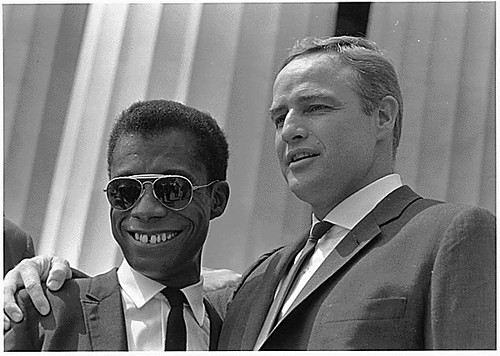
Marlon Brando and James Baldwin
at 1963 March on Washington
Dear Rich: I wanted to post some photos for a celebrity article at my website. I’ve totally forgotten rules regarding photos. Can I pilfer IMDB and give an attribute to them or do I actually need their permission? Are there any secret public domain photos for celebs you know about? The copyright in celebrity photos is owned by the photographer (or by the agency to whom the photographer has transferred rights). We doubt whether the IMDB owns rights in all the photos it posts. Most likely, it's acquired those rights from the copyright holders. Often large celebrity-styled sites have ongoing 'subscription' deals with the companies that own photo rights such as Getty Images, PR Photos, PictureLux, and Shutterstock.
Operating without clearance. If you work for a website company, you're best off not jeopardizing your job by using unauthorized photos. The price you'll have to pay -- time, threats, lawsuits and payments -- if you're caught will far outweigh the licensing costs. If you're just posting a photo occasionally to your personal blog, you're less likely to get hassled but beware that photo agencies employ various means of tracking digital photo use including digital watermarks and embedded metadata.
Right of publicity. The rules we provide here are for websites where you are using the celebrity photo as a means of illustrating a story about the celebrity -- for example, you're discussing the funny side of Mike Tyson. If you are using the celebrity photo to imply endorsement of your site or to sell a product or service, you'll need the celebrity's permission as well.
Public domain photos. There are some public domain photos of celebrities. Try sites such as Wikimedia and read and observe the terms of the licenses. We're not so sure about so-called public domain photos at other sites -- that is, whether the photos are actually in the public domain. We typed in "public domain celebrity photos" and found mixed results (including pictures of Dwight Eisenhower and Britney Spears -- we don't want to think about the potential mash-up!). Of course photos taken by government employees -- for example, Elvis shaking hands with President Nixon (soon to be a movie) are in the PD. We think that's the case with our photo of Marlon Brando and James Baldwin (above) -- perhaps taken by an FBI agent. (And here's a related video made around the same time).

Using 70's Voice Over in New Music Track


Dear Rich: I'm in the final stages of producing a music single. In the song I've sampled the voice-over of a 1970's TV ad. The voice-over is of a familiar and famous figure from that period. Would I need to clear this and for this purpose with whom, as I assume in this case that no record company or music publisher would be involved. We're not sure which familiar and famous person's voice-over you're using but if you're creating a second single, you might want to consider a classic 70s TV ad in which a size-challenged nautical figure -- perhaps a descendant of this character -- rides around in a boat in your toilet and urges consumers to pollute the waters with blue chemicals. How '70s is that?
Right you had a question. You're correct that you wouldn't need to clear the voice-over recording with a music publisher or record company. You may not need any permission at all, as explained below, but there are three possible legal rights you need to consider:
  • the copyright on the commercial. The most likely permission needed is that of the copyright holder -- that's likely to be the ad agency that created the commercial, or the company whose product is featured in the commercial. The copyright owner would own rights to the text of the commercial and to the audio. You wouldn't need permission if you claimed fair use (which can always be a bit tricky). And you probably wouldn't need to bother with permission if the company holding copyright had disappeared and you couldn't track down a successor. (And of course, you wouldn't need permission if your song had limited appeal and was unlikely to be heard by anyone connected with the copyright owner -- what we call the "tree falls in the forest" theory.)
  • the use of the famous figure's voice.  If the familiar and famous person's (FFP) voice is recognizable and listeners think that it is being used for purposes of endorsement, the FFP might have a claim based on the right of publicity. We wouldn't worry about this too much because the FFP's ROP probably won't be triggered unless the song is used for a 3rd party commercial purpose -- that is, it's licensed for use with another product or service (This article provides a short ROP summary). 
  • trademark rights. If the product name (the subject of the commercial) is included in your song, that might trigger claims of dilution or infringement but both of these claims are unlikely to succeed as use of trademarks is permitted for informational (or editorial) uses such as songs. One judge characterized the conflicting interests of the parties "Speech-zilla v. Trademark Kong.


Are Nonprofits Liable for Photo Infringement?

Dear Rich: I have been collecting black-and-white snapshots at antiques shops and flea markets for several years. This year i started posting some of them with slightly irreverent captions on my website. I think I understand that orphan works produced before 1923 are considered to be in the public domain. But what about the later photos? I haven't been too concerned about copyright violations because it is a nonprofit site. However what if I wanted to reproduce the images for profit? What kind of legal issues would I face? We think you're operating under a few misconceptions so maybe we should clear those up, first.
Nonprofits can be liable for infringement. Being a nonprofit won't shield you from a lawsuit. Nonprofits are occasionally named as defendants -- for example, the Internet Archive was sued over its caching of old web pages (and some nonprofits have filed suits as well). Nonprofit status may affect fair use determinations (as explained here). But in general, it makes little difference for purposes of determining infringement, whether the theft was for profit or not. You should also be aware that nonprofit status is a corporate tax status; a failure to profit doesn't make you a nonprofit.
Orphan works are not public domain. You are correct that works published in the U.S. before 1923 are in the public domain in the U.S. But these are not orphan works. An orphan work is one that is still protected under copyright but whose owner is missing in action and there's nobody to contact for permission. We think that's the case with most of the photos at your website.
Right, you had a question. We think the odds are slim that you will be the subject of a lawsuit. A copyright owner of one of your vintage photos (the owner would be whoever took the picture) is unlikely to see your work, unlikely to threaten a lawsuit and unlikely to recover much if the lawsuit should it actually go to court. So the chances are low that you will be hassled. Still, for the record, these are infringements. There is also a slim possibility that one of the subjects of these photos will see your site and claim an invasion of privacy or (if you sell the images) a violation of the right of publicity.  Again, unlikely, but possible ... kind of like guessing whether an earthquake will hit Virginia.

Has Roy Orbison Negatives

Dear Rich: I read an article about a man who took pictures of the Beatles when he was a teen and recently sold them. That got me thinking about my 23-year old negatives I have of the singer Roy Orbison and his family. I was working on a Christmas card for the family and shot several rolls of film. A month and a half after the photo shoot Mr. Orbison passed away. As the photographer I had them sign a release and I still maintain the negatives. Question is: Do I have the right to print and market those images? If so, what do I need to market images and how far may I go in creating additional marketable images? OMG! We just realized Roy Orbison has been gone for almost 25 years! It seems like yesterday that the In Dreams star passed away. What has the Dear Rich Staff been doing all these years?
Right, you had a question. The short answer is that you can sell copies of your photographs (prints) and you can license the photos for editorial uses such as books and website articles. But you cannot license them for commercial uses such as product endorsements or merchandise unless such rights were conveyed to you by the people signing the releases (unlikely).
The longer answer. There are three legal principles at work: copyright, contracts, and the right of publicity. Unless the photos were done under an employment relationship, copyright grants the photographer (the person who took the pictures) the right to copy and create derivatives of the photos.  The right of publicity allows the subject of the photo to control the way their image is used for endorsements and merchandise. Contracts are used to transfer these rights. So, the photographer retains copyright unless a contract transfers that right and the subject retains the right of publicity unless that right is transferred by contract (for example, a release). For that reason, you will obtain the most reliable answer after someone reviews your photo releases to determine what rights were granted to you.

Model Releases for Street Festival

Participants in San Francisco's
Bay to Breakers Race/Party
Dear Rich: I have a question about model releases for a large, public, 2-day street festival. From what I can determine, I would not need a model release from the attendees that I photograph (there will be LOTS of them) unless I sell them, even if they are recognizable and the main subject of the photo. Is this correct? If the photos were to be sold or used commercially, would a release be required? If a release is necessary (even if it is just to cover our butts), to ease the burden of obtaining hundreds of model releases each day (I would not have time to take pictures!!), would it be legally binding to have a sign at the entrance to the festival (or printed on the tickets) stating something like: "Photographs will be taken during this festival. Selected photographs could be used commercially and in festival promotions. If you do not wish to have your photo taken, please inform the photographer." Yea! It's summer and the time for street fairs. We remember being in bands and playing at certain street fairs in San Francisco where photography would have been a problem because of the lack of a dress code (unless wardrobe malfunction counts as a dress code).
Right, you had a question(s). Photographers can reproduce and sell copies of photos of people in publicly viewable situations like street fairs. Newspapers and websites can reproduce those images if the pictures are used for "informational" purposes. But an advertiser can't use the same images of people to sell products or services if the person in the ad is clearly recognizable. That's because the advertising use implies that the person endorses or is somehow associated with the product.
Can you use a blanket release? Posting a sign may help your claim and it could be sufficient to use the photos to promote the street fair. But it probably doesn't meet the standards of a model release contract required for most commercial advertising uses. That's because the street fair participant doesn't really have an opportunity to assent to or to reject the release (something that is much easier to do if people have to pay for the tickets). Your present opt-out is for the participant to tell the photographer, 'No.'  But what if the participant isn't paying attention when the photo is taken and doesn't notice the photographer? Our suggestion is that if you take a photo and feel certain it would make for a good commercial use, use a short business card-sized release. (Here's some detailed information by the Dear Rich Staff on when and how to use model releases, and here's more on the right of publicity.)